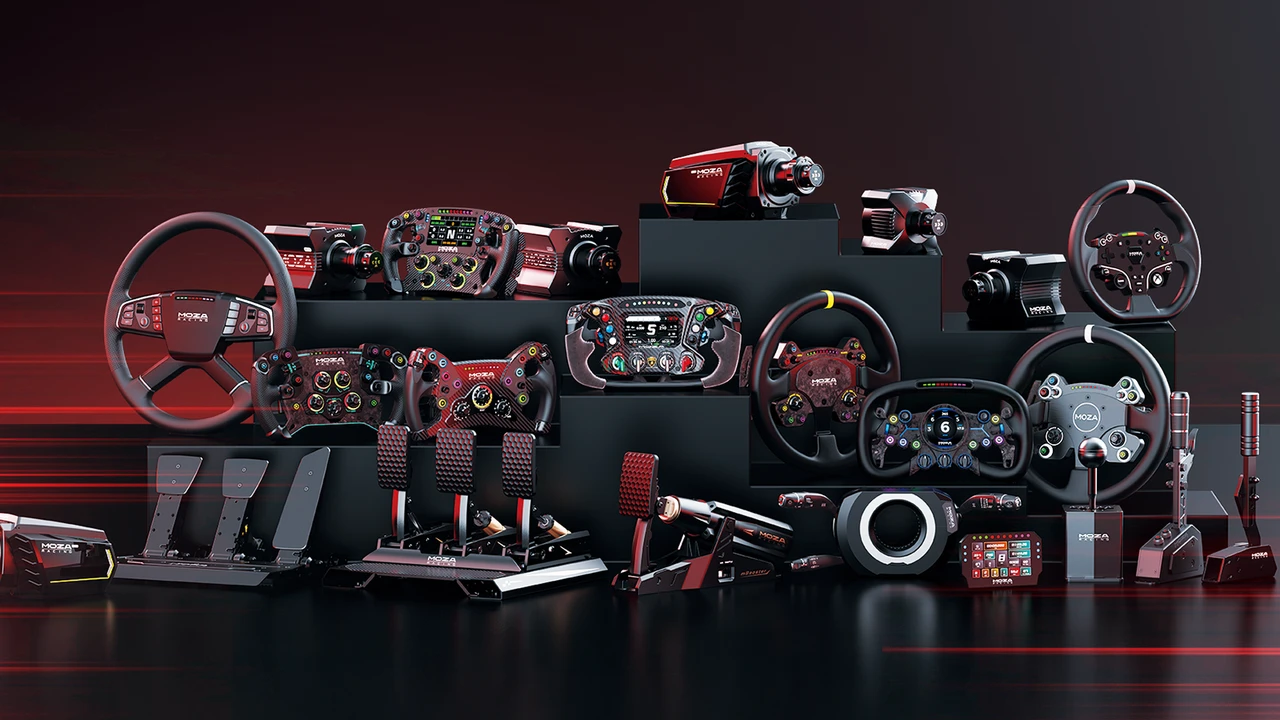
With the wave of new GT and prototype rims revealed this fall—led by the Sim-Lab GTSL Ultimate steering wheel, the Simagic KTM X-Bow GT2 wheel, and Logitech G RS Series modular rims—many sim racers are deciding whether a 280mm, 300mm, or 320mm wheel belongs on their direct drive shaft.
Even if your wheelbase motor outputs the exact same peak Newton-meters, changing the outer diameter and weight of your steering wheel completely alters how that force feels in your hands.
Shortest lever arm from the motor shaft. Delivers the sharpest, heaviest force feedback and lightning-fast direction changes in high-downforce single-seaters, but can feel overly twitchy in heavier GT3 or touring cars.
The sweet spot for modern GT3, GT4, and LMDh prototypes. A 300mm width gives you finer steering resolution to hold the 6-to-9 degree peak tire slip angle window without tiring your shoulders over a two-hour stint.
Essential for hand-over-hand slides in rally, stock cars, and street driving, though the wider radius and extra rim mass soften high-frequency road texture on 5 Nm to 9 Nm entry-level bases.
Matching Rim Weight to Your Wheelbase Torque
Because torque equals force multiplied by radius, moving from a 280mm rim to a 320mm rim increases your leverage over the motor by roughly 14%. On a 9 Nm or 12 Nm wheelbase, keeping rim weight low—whether you are running a carbon-plated endurance wheel like the Sim-Lab GTSL Ultimate or even experimenting with lightweight home builds like the MandićLab Easyrace 3D-printable wheel—preserves crisp self-aligning speed when catching oversteer.